Bathroom safety risks for older adults and how to reduce falls
By Dana Whitfield · Updated 2026-08-11
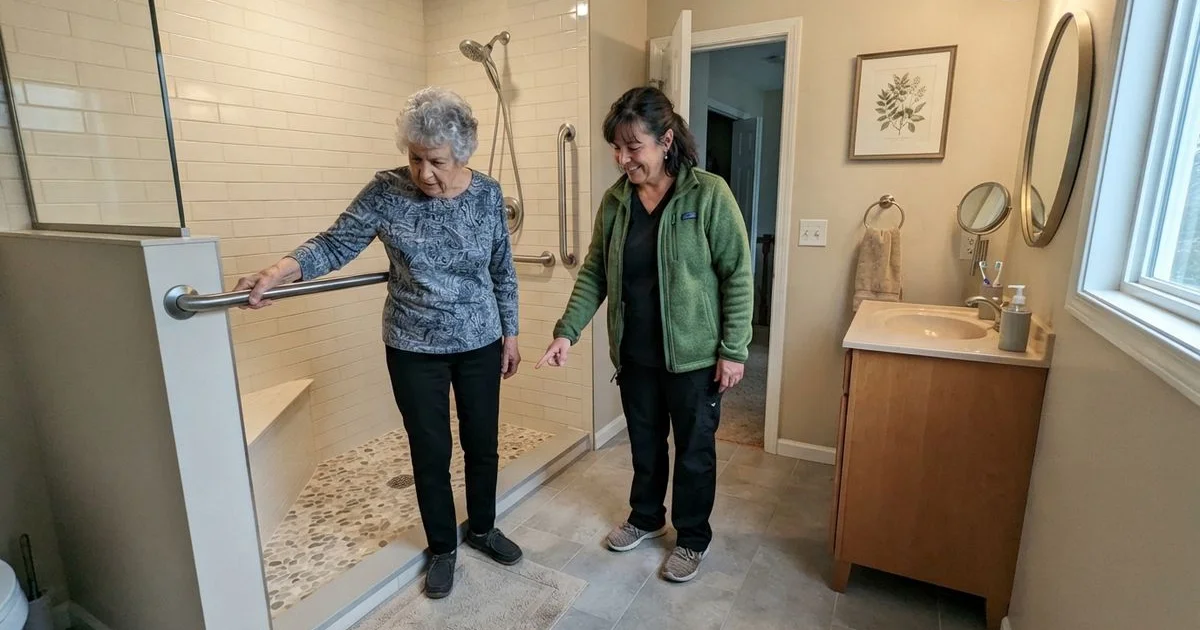
This guide covers general safety information, not medical advice. For an assessment specific to an individual’s mobility or health needs, consult a physician or occupational therapist.
Bathrooms are one of the most common places for falls among older adults, and the reasons are mostly mechanical: hard, wet, slippery surfaces combined with a tub or shower entry that requires stepping over an edge at the exact moment a person’s balance is least stable. The good news is that most of the risk factors have straightforward fixes.
The main hazards, and why they matter
- Tub walls and shower curbs. Stepping over a raised edge onto a wet surface is a leading fall scenario, since it requires balance on one leg at the highest-risk moment.
- Slippery flooring. Standard tile and porcelain surfaces get slick when wet, especially without a textured or slip-resistant finish.
- No secure grab point. Towel bars are not rated to bear body weight and can fail under sudden load, unlike a properly anchored grab bar.
- Low or unstable seating. A standard-height toilet requires more effort and knee strain to sit and stand from than a comfort-height model.
- Poor lighting. Dim or single-source lighting makes it harder to judge footing, especially at night.
Changes ranked by cost and impact
| Change | Typical cost | Impact |
|---|---|---|
| Grab bars (properly anchored) | $150 – $400 installed | High impact, low cost |
| Non-slip flooring or treatment | $300 – $900 | High impact, moderate cost |
| Comfort-height toilet | $250 – $600 | Moderate impact |
| Curbless or low-threshold shower conversion | $9,500 – $17,000+ | Highest impact, addresses the biggest single risk factor |
| Full accessibility remodel (wider doorway, roll-in shower, layout change) | $8,000 – $12,000+ depending on scope | Covers the whole room, best for higher mobility needs |
Why grab bars need to go where a professional puts them
A grab bar has to be anchored into a wall stud or into blocking installed specifically to support it, not just screwed into drywall. Drywall alone cannot reliably hold the sudden, full-body-weight load a person puts on a grab bar during an actual loss of balance, which is precisely the moment it needs to work. If a bathroom does not already have grab bar blocking behind the wall in the right spot, a contractor will need to open the wall briefly to add it, which is worth doing right the first time rather than relying on a surface-mounted bar rated for towels, not weight-bearing use.
Starting with the highest-impact, lowest-disruption changes
If a full remodel is not the right step yet, start with grab bars, non-slip flooring, and a comfort-height toilet. These three changes address a large share of the fall risk without the cost or disruption of removing a tub or reconfiguring the room, and they can often be done in a single day. A curbless shower conversion or full accessibility remodel is the next step when mobility needs are more significant or clearly increasing.
Revisiting the plan as needs change
Mobility needs are rarely static, so it is worth revisiting whether the current bathroom setup still fits every year or two, rather than treating a single round of changes as permanent. A person who manages fine with grab bars and non-slip flooring today may need a curbless shower or additional support down the line, and planning for that possibility, even loosely, makes a future change easier when it becomes necessary.
Getting the work done right
Because the safety benefit depends entirely on correct installation, this is not a project to shortcut. Accessible and aging-in-place remodeling specialists on this site focus specifically on this kind of work, which matters more here than in a purely cosmetic project.
If cost is a barrier to making these changes, it is worth checking what financial assistance may be available before ruling out the higher-impact options, since several state and local programs exist specifically to help older adults age safely in place. Comparing a couple of Connecticut bathroom remodelers who list this specialty is a reasonable next step once you know roughly what scope fits the situation.
This site’s approach to evaluating and ranking those specialists is explained on the methodology page.
Questions people ask
- What is the most common cause of bathroom falls for older adults?
- Stepping over a tub wall onto a wet floor is one of the most common scenarios, combined with a lack of a secure grab point at the exact moment balance is needed. Slippery flooring and poor lighting compound the risk.
- Do grab bars need to be professionally installed?
- Yes, if they are being anchored properly. A grab bar has to be secured into wall studs or reinforced blocking to hold real body weight; one mounted only into drywall can pull loose exactly when it is needed most.
- Is a full accessibility remodel necessary, or do smaller changes help?
- Smaller changes help meaningfully on their own: grab bars, non-slip flooring, and a raised toilet address a large share of the risk at a fraction of the cost of a full remodel. A full remodel makes more sense when mobility needs are more significant or expected to increase.
- How do I bring up bathroom safety with a parent who is resistant to changes?
- Framing it around independence rather than decline tends to land better: grab bars and a walk-in shower are what let someone keep showering on their own terms, not a sign they can no longer manage. Starting with the least visible changes, like non-slip flooring, can also ease into the conversation.
Related on this site
- Browse accessible & aging-in-place remodeling providers
- Financial assistance for aging-in-place bathroom modifications in Connecticut
- Helping an aging parent remodel their bathroom for safety and independence
- Lead paint safety when remodeling a bathroom in an older Connecticut home
- Bathroom electrical and ventilation safety: what Connecticut code requires
- All guides →